
We all know that practice is the only way to get better. Not all practice methods are created equal though. So how do you get the most our of your practice sessions? What’s the best way to structure them?
After years of devising complicated practice structures. I finally came up with a something simple and effective. It’s a practice plan that’s worked for both myself, and my clients over the last twenty or more years.
My Simple Practice Structure
Divide whatever practice time you have into three equal parts:
- Technical
- Vocabulary
- Application (fun!)
Got 6 minutes? Do two minutes of each. Got an hour, do 20 minutes of each. It’s as simple as that.
If you’re not in the mood for practice, I’d recommend doing just sections 1 + 3. Do a little bit of technique to keep you progressing, and then just play and have some fun. That’s why we do this whole music thing after all, right?
Here’s what I do in each part:
Technical
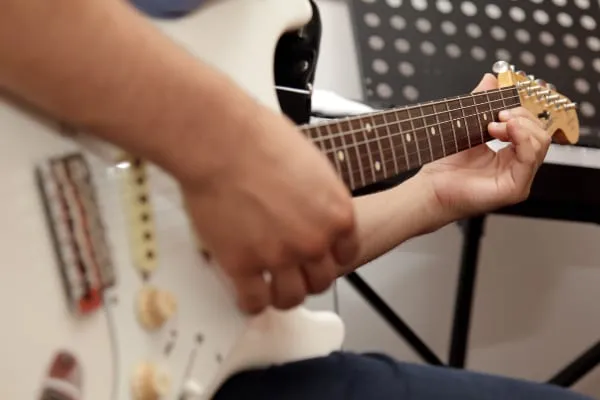
Practice the skills that you’ll need to improve your ability to express. If you have difficulty saying a word, your less likely to use it in a sentence. That’s what technique is for, to give you freedom to express yourself. Work on making playing your instrument (or singing) effortless. As soon as it’s easy it will be good. As a guitarist, I work on string crossing, position changing and synchronisation. What you work on will depend on your instrument.
Vocabulary
Scales, chords, scale sequences, chord patterns. Any vocabulary that you use to express yourself. You may use this vocab as a performer, composer or improviser.
Why learn scales? They’re great ear training (as well as good for the fingers). You can use them to improvise or to compose. Scale patterns are even better. Chord patterns are great to know too if you play a chordal instrument. They’ll help you figure out songs by ear with ease.
Connecting your ‘internal ear’ to your muscles is critical. That way, when you hear a sound you can play it without having to think about it. Your brain will know the finger patterns that a particular sound makes on your instrument.
Application (fun!)

No one wants to listen to a good practicer, they want to listen to a good player. As such, it’s something that you’ve got to work on. Practice playing pieces, getting the emotional content of a piece across to the audience.
Try recording a chord progression (or using some software to create one) and then try improvising over the top.
Figure out a piece of music by ear. The more you do it, the faster you’ll get at it and you’ll also become a much better musician. Having a good ear is the most important skill you can have as a musician. Transcription, or figuring things out by ear is one of the best ways to develop that.
Any of these make great things to practice during that ‘Application’ part of your practice.
Practice Every Day
Don’t forget. You don’t need to practice for hours. You’re better off doing a little bit everyday. You’ll get much more benefit that way. Especially if you use the method above. It will help you develop into a well rounded musician.
If you’ve got questions or your own awesome practice methods, feel free to share them in the comments.
Independent Music Academy — Brisbane’s Premier Music School.
Book an introductory music lesson and start following your musical dreams.